Showing posts with label Reuters. Show all posts

Thursday, May 5, 2016

No wedding tents for child marriages, Indian suppliers vow
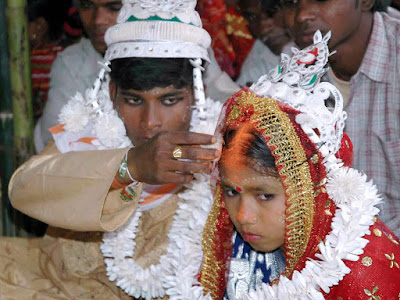

MUMBAI (Thomson Reuters Foundation) - Suppliers of wedding tents may not be the most obvious allies in the battle to prevent child marriage, but in India's Rajasthan state they have come together to tackle some of the highest rates of early marriage in the country.The Tent Dealers Welfare Samiti (Association) of Rajasthan, which has more than 9,000 members, has been demanding to see the birth certificates of the brides and grooms it has been supplying.
In India, the legal age of marriage for a woman is 18 and 21 for a man. The charity Girls Not Brides estimates the rate of child marriage to be as high as 65 percent in Rajasthan and almost 70 percent in the eastern state of Bihar.
The tent dealers association has stopped at least 80 child marriages in Rajasthan in the past two years, its president Ravi Jindal said.
"We want to show people that this is wrong, that they should not be doing this," Jindal told the Thomson Reuters Foundation. "We complain to the police and the village headman, get them to intervene, so there is pressure on them to not do it."
Despite their efforts, and similar actions by thousands of suppliers across the state, the practice is rampant, he said.
In Rajasthan, a state famed for its palaces and forts, weddings peak during the Akshaya Tritiya festival in April and May, which is considered an auspicious period.
Colorful tents decorated with flowers and lights are often erected for guests to enjoy the wedding feast.
Worldwide, more than 700 million women were married before their 18th birthday, according to a 2014 UNICEF report.
While boys are also married as children, girls are disproportionately affected, it said. Early marriage makes it more likely that girls will drop out of school, and campaigners say it also increases the risks of exploitation, sexual violence, domestic abuse and death in childbirth.
South Asia is home to 42 percent of all child brides worldwide. India alone accounts for one-third of the global total, according to UNICEF.
Child marriage is most common in rural areas and among the poor, where a girl is seen as a financial burden, said Sanjay Sharma, general manager at the Save the Children charity in Rajasthan.
Girls are also married early because of fears for their safety, he said.
"It is not as though people are not aware of the law, that it is not permitted," Sharma said.
"But they say it is their tradition. So every little action helps, be it from the police, from the government or tent suppliers," he said.

(Reporting by Rina Chandran, Editing by Katie Nguyen.; Please credit the Thomson Reuters Foundation, the charitable arm of Thomson Reuters, that covers humanitarian news, women's rights, trafficking, corruption and climate change. Visit news.trust.org to see more stories.)

Tuesday, March 29, 2016

Iran vows to pursue missile program despite new U.S. sanctions

Iran vows to pursue missile program despite new U.S. sanctions

Iran will pursue its development of ballistic missiles despite the U.S. blacklisting of more Iranian companies linked to the program, a senior Revolutionary Guards commander said on Monday.

The Islamic Revolutionary Guards Corps (IRGC) test-fired several ballistic missiles this month, drawing condemnation from Western leaders who believe the tests violate a United Nations resolution.

The U.S. Treasury Department blacklisted on Thursday two Iranian companies, cutting them off from international finance over their connection to the missile program.

Washington had imposed similar sanctions on 11 businesses and individuals in January over a missile test carried out by the IRGC in October 2015.

"Even if they build a wall around Iran, our missile program will not stop," Brigadier General Amir Ali Hajizadeh, commander of the IRGC's aerospace arm, was quoted as saying by Tasnim news agency. "They are trying to frighten our officials with sanctions and invasion. This fear is our biggest threat."

U.S. officials said Iran's missile test would violate U.N. Security Council Resolution 2231, which calls on Iran not to conduct "any activity" related to ballistic missiles capable of delivering nuclear weapons.

However, Washington said that a fresh missile test would not violate a July 2015 accord under which Iran has restricted its disputed nuclear program and won relief from U.N. and Western financial sanctions in return. That agreement between Iran and six world powers was endorsed in Resolution 2231.

The Revolutionary Guards, Iran's elite fighting and security force, maintains dozens of short and medium-range ballistic missiles, the largest stock in the Middle East. It says the missiles are solely for defensive use with conventional, non-nuclear warheads.

President Hassan Rouhani, a pragmatic conservative, said on Sunday that boosting Iran's defense capabilities is a "strategic policy" though Iran should take care not to provoke its enemies.

"We will pursue any measure to boost our defense might and this is a strategic policy," Rouhani was quoted as saying by Press TV in the first cabinet meeting in the new Persian year.

"But at the same time we should remain vigilant so that Iran's enemies do not find any excuse to take advantage of the situation."

Iran has denied U.S. accusations that it is acting "provocatively" with the missile tests, citing a long history of U.S. interventions in the Middle East - including a U.S.-engineered coup in Tehran in 1953 - and a right to self-defense.

(Reporting by Bozorgmehr Sharafedin; Editing by Mark Heinrich)

Iran's Rouhani says can provide Pakistan gas through pipeline within months

Iranian President Hassan Rouhani said on Saturday that Iran had completed work on its side of a much-delayed pipeline pumping natural gas to Pakistan and would be in a position to provide gas to its energy-starved neighbour in a few months.
Rouhani spoke at a news conference while in Pakistan for two days of talks focused on increasing Pakistan's electricity imports from Iran, boosting trade relations and reviving plans for a pipeline between the two countries.
"Iran has constructed this gas pipeline up to the border of Pakistan and we are ready to deliver the gas to Pakistan at our borders. We have almost completed our share," Rouhani said. "It is now up to Pakistan to initiate work on its side."
Dubbed the "peace pipeline", the $7 billion gas project has faced repeated delays since it was conceived in the 1990s to connect Iran's giant South Pars gas field to India via Pakistan.
India quit the project in 2009, citing costs and security issues, a year after it signed a nuclear deal with Washington.
The United States had opposed Pakistani and Indian involvement, saying the project could violate sanctions imposed on Iran over its nuclear activities.
Most of the sanctions were lifted in January in return for Iran complying with a deal to curb its nuclear ambitions.
BOOSTING TRADE
At Saturday's news conference, the Iranian president said Iran was also interested in connectivity between Pakistan's southern port of Gawadar and the Chabahar port in southeast Iran through roads and shipping lines.
He said Iran was already selling 1,000 MW of electricity to Pakistan and would increase this up to 3,000 MW.
Speaking at a business conference with Rouhani earlier in the day, Pakistani Prime Minister Nawaz Sharif said Pakistan and Iran had signed an agreement to increase annual trade volumes between the two countries to $5 billion by 2021.
On Friday, the Pakistani premier said Pakistan would open two new crossing points on its border with Iran, helping to encourage trade hampered by years of Western sanctions against Tehran.
Trade between Pakistan and Iran fell to $432 million in 2010-11 from $1.32 billion in 2008-09, according to the Trade Development Authority of Pakistan. 
Energy-starved Pakistan suffers about 12 hours of power cuts per day and is keen to import Iranian oil, gas, iron and steel.
Iran is interested in Pakistani textiles, surgical goods, sports goods and agricultural products.

Pakistan also plans to set up industrial sites in the impoverished border area, especially for petrochemicals storage, and link the infrastructure to a $46 billion project with China dubbed the China-Pakistan Economic Corridor.

Bangladesh dismisses case to drop Islam as state religion

Bangladesh's High Court on Monday dismissed a case filed by a citizen's group to drop Islam as the state religion, a lawyer said.
Bangladesh's 1971 constitution declared all religions were equal in the eyes of the state. But military ruler Hussain Mohammad Ershad amended it in 1988 to make Islam the state religion.
Ershad's action led a group of 12 citizens to file a writ with the High Court to overturn the amendment. But Shahriar Kabir, who convened the group, said the members decided not to go ahead with the case.
Twenty-eight years later, the same group filed a new writ which the court dismissed.
Subrata Chowdhury, the lawyer for the group, said the court did not even allow them a hearing. It did not give a reason for dismissing the case.

The government, led by Prime Minister Sheikh Hasina, has amended the constitution to reinstate the principle of secularism but also reaffirmed Islam as the state religion.

Pakistan detained more than 5,000 after Easter bombing killed 72

Pakistan has rounded up more than 5,000 militant suspects, then released most of them, in the two days since a suicide bomber killed at least 72 people in a park in Lahore at Easter, a provincial minister said on Tuesday.
Investigators were keeping 216 suspects in custody pending further investigation, said Rana Sanaullah, a state minister for Punjab province from Prime Minister Nawaz Sharif's ruling party.
Details of the sweeping raids aimed at anyone suspected of violent Islamist extremism came as the Taliban faction claiming responsibility for the attack issued a new threat on Tuesday, singling out the media.
Sanaullah said "5,221 people have initially been detained. 5,005 have been released after verifying their identities, and 216 people have been referred for further investigation.
"If someone is found to be guilty, they will be charged," told journalists in the Punjab province capital of Lahore.
Army spokesman Gen. Asim Bajwa said the military and the paramilitary Rangers were conducting raids across Punjab, Pakistan's richest and most populous province, in rapid response to the Easter bombing.
"Right now in Rawalpindi, Multan and elsewhere, operations are ongoing, intelligence agencies and Rangers and army troops are carrying out operations," he told reporters in Islamabad.
MILITANT THREAT
Jamaat-ur-Ahrar, the Taliban faction that claimed responsibility for the blast aimed at Christians celebrating Easter, warned Pakistani media they could be the next target.
"Everyone will get their turn in this war, especially the slave Pakistani media," Ehsanullah Ehsan, spokesman for the group, tweeted. "We are just waiting for the appropriate time."
Even as authorities pursued Islamist militants across Punjab, hundreds of ultra-conservative Muslim protesters remained camped out in front of parliament on Tuesday in the capital, Islamabad, days after clashing with police.
Mobile phone networks in the capital were blocked for security purposes for a second day in a row.
The Easter bombing was Pakistan's deadliest attack since a 2014 school massacre claimed by the Taliban killed 134 students.
The attack, which included 29 children among the 72 dead, showed the militants can still cause carnage despite military raids on their northwestern strongholds.
Lahore is the capital of Punjab, Pakistan's richest and most populous province and Sharif's political heartland.
"Let Nawaz Sharif know that this war has now come to the threshold of his home," tweeted Ehsan. "The winners of this war will, God willing, be the righteous mujahideen."
Sanaullah said at least 160 raids have been carried out since Sunday night by a mixture of police, counter-terrorism and intelligence agents and confirmed that army and paramilitary forces would be used in future operations.
"This operation will include all law enforcement agencies," Sanaullah said.
MILITARY CAMPAIGN
Military and government officials on Monday said that the army was preparing to launch a new paramilitary counterterrorism crackdown in Punjab, as it did more than two years ago in the violent southern megacity of Karachi.
By allowing this, the civilian government once again ceded special powers to the military to fight Islamist militants.
Punjab provincial leaders, particularly among Prime Minister Sharif's party, have long resisted suggestions of bringing in the paramilitary Rangers to fight extremism in reported centres of radicalism including Multan in southern Punjab.
In Karachi, the Rangers' crackdown has cut back the rate of militant and criminal violence sharply, but also drawn accusations of human rights abuses and the targeting of opposition politicians.
A possible renewal of their mandate by the Sindh provincial government is the subject of heated debate there.
Army spokesman Gen. Bajwa said the government had agreed to send whatever forces are most appropriate to capture extremists.
Jamaat-ur-Ahrar, which has declared loyalty to Islamic State, has carried out five major attacks in Pakistan since December.
In recent years, Pakistan has cracked down on movements that target its own citizens and institutions, including the Pakistani Taliban who are fighting to topple the government and install a strict interpretation of Islamic law.
The army and former governments have been accused of fostering hard-line religious movements to boost their own support and to use militant groups to help pursue objectives in Afghanistan and against Pakistan's old rival India.
However, moves by the government to crack down on extremism have prompted a backlash.
The recent outpouring of anger over the execution in late February of ex-bodyguard Mumtaz Qadri, who assassinated the Punjab governor he guarded because the politician campaigned against Pakistan's harsh blasphemy laws, highlights the tension.

The demonstrators, incensed by the hanging of a man they consider a hero for defending Islam, now demand the immediate execution of hundreds of people in jail on blasphemy charges.

Wednesday, March 9, 2016

Pakistan hints at progress on Taliban talks within days


Pakistan has played down the Taliban's rejection of proposed peace talks with the Afghan government, saying on Tuesday that it hoped for progress "in coming days".
Sartaj Aziz, foreign policy adviser to Pakistan's prime minister, said his country, the United States and China would use their influence to persuade the Taliban to come to the table to try to end a nearly 15-year-old war.
"I hope in the coming days some progress (can be made) ... at some level, and once we start, we hope they will gather momentum," he told a press briefing in Islamabad alongside British Foreign Secretary Phillip Hammond.
Officials had said they expected direct peace talks between the Afghan government and the Taliban to begin in early March following a meeting of the so-called Quadrilateral Coordination Group, made up of representatives of Afghanistan, Pakistan, China and the United States, in February.
But the Taliban, which calls itself the Islamic Emirate of Afghanistan, said last week it would not participate.
The group said it would only join talks once all remaining foreign troops left Afghanistan, its leaders were removed from a U.N. terrorist blacklist and its prisoners freed from Afghan jails.
Pakistan's Aziz said he felt the Taliban could be persuaded.
"Many of the preconditions that they are looking for can come as a result of negotiations and not in advance of them," he said, adding that the Afghan government had in the past expressed willingness to exchange prisoners.
Violence has increased in Afghanistan since the withdrawal of most foreign combat troops in 2014, leaving the newly trained Afghan police and army to fight the Taliban.
Last year, the Taliban captured a provincial capital for the first time since their hard-line Islamist government was toppled by a U.S.-led invasion in 2001.
(Writing by Kay Johnson; Editing by Robin Pomeroy)

Kidnapped son of slain Pakistani governor rescued after four years


The kidnapped son of a Pakistani governor who was murdered after he criticised the country's blasphemy laws was freed on Tuesday, a week after his father's killer was executed, authorities said.
Shahbaz Taseer, in his 30s, had been missing for more than four years, ever since he was abducted in Lahore months after his father, Punjab Governor Salman Taseer, was killed in 2011.
The Pakistani army said Shahbaz Taseer had been rescued by intelligence agents in the southwestern province of Baluchistan. Provincial officials confirmed the news.
"Shahbaz was recovered safe and sound," Baluchistan police inspector general Ahsan Mehboob told Reuters. Intelligence agents and counter-terrorism officers found Taseer after receiving information he was being held in a hotel in Kuchlak, 25 km north of Quetta, the provincial capital, Mehboob said.
No arrests were made in the raid, and there was no confrontation with the captors, he added.
Last week, Salman Taseer's former bodyguard, Mumtaz Qadri, was hanged for the murder. The killer's funeral attracted tens of thousands of supporters who proclaimed him a hero for defending Islam.
On Monday, a suicide bomber killed at least 10 people near a court, an attack the Pakistani Taliban's Jamaat-ur-Ahrar faction said it had committed to avenge Qadri's execution.
Salman Taseer had spoken in support of a Christian woman sentenced to death for blasphemy and had called for the laws that mandate the death penalty for insulting Islam to be revised. After his death, Taseer's family received multiple threats from religious hard-liners.
On the day of Qadri's execution, another of Taseer's sons, Shehryar, tweeted: "MumtazQadri being hanged is a victory to #Pakistan. NOT the #Taseer family. The safe return of my brother is the only victory my family wants."
Shahbaz Taseer was believed to have been kidnapped originally by the radical Islamist group Lashkar e Janghvi and later handed to al Qaeda and then to the Pakistani Taliban, intelligence sources told Reuters.
(Reporting by Syed Raza Hassan and Asad Hashim; Writing by Kay Johnson; Editing by Larry King)

Criminals in Bangladesh heist likely studied bank's inner workings


The perpetrators of a $100 million digital heist at Bangladesh's central bank had deep knowledge of the institution's internal workings, likely gained by spying on bank workers, security experts said.
Unknown hackers breached Bangladesh Bank in early February, stole credentials for payment transfers and then ordered transfers out of a Federal Reserve Bank of New York account held by Bangladesh Bank, according to Bangladesh Bank officials.
Bangladesh government officials blamed the Fed for the attack when they disclosed the loss. The New York Fed responded on Tuesday saying there was no evidence its systems were compromised in the attack, one of the biggest bank thefts in history.
The Fed said it followed normal procedures when responding to requests that appeared to be from Bangladesh Bank, which were made and authenticated over SWIFT. Belgian-based SWIFT, a member-owned cooperative that banks use for account transfer requests and other secure messages, declined to comment on specifics of the case.
Security experts said that to pull off the attack, cyber criminals had to first gather information about Bangladesh Bank's procedures for ordering transfers, so that the fraudulent requests would not raise red flags.
In addition to stealing credentials for processing transfers, the hackers likely spied on Bangladesh Bank staff to get a deep understanding of the central bank's operations, according to experts in banking fraud.
Kayvan Alikhani, a senior director with security firm RSA, said that in addition to user names and passwords for accessing SWIFT, the hackers likely needed to obtain cryptographic keys that authenticated the senders.
Such certificates can be copied and used by impostors if they are not properly secured, he said.
“You are only as good as your weakest link when getting access to the SWIFT network and doing a transfer,” Alikhani said.
In a round of robberies disclosed last year, a group dubbed the Carbanak gang hacked into a number of banks around the world, seized control of computers that access SWIFT, then ordered fraudulent transfers. (reut.rs/1R6aonj)
They siphoned money through SWIFT after observing how bank employees crafted their messages so they could follow correct protocols, said Juan Guerrero, a researcher with Kaspersky Lab, which studied the campaign.
"The genius of the attacker in the Carbanak case is taking the time to learn directly from the victim and thus bypass fraud prevention measures through sheer mimicry,” Guerrero told Reuters.
Another hacking method that could have been used is known as "social engineering," where attackers play on human psychology to manipulate victims.
They get that information by hacking email accounts of employees who process transfers, said Tom Kellermann, a former member of the World Bank's security team.
"They sit and watch regular communications to understand when somebody would be most receptive to a specially crafted social-engineering email instructing them to make the transfer," said Kellermann, now chief executive of investment firm Strategic Cyber Ventures.
(Reporting by Jim Finkle; Editing by Jonathan Weber and Phil Berlowitz)

U.S. senator does not expect Pakistan F-16 sale to be blocked


U.S. Senator Ben Cardin, the top Democrat on the Senate Foreign Relations Committee, said on Wednesday he does not expect an upcoming vote on a $700 million sale of F-16 fighter jets to Pakistan to keep the deal from going ahead.
However, he said there was still discussion of whether U.S. taxpayer funds could be used to finance the purchase.
President Barack Obama's administration announced on Feb. 12 that it had approved the sale of the Lockheed Martin Corp (LMT.N) aircraft as well as radars and other equipment to Pakistan.
It drew immediate criticism from India and concern from some members of Congress.
Republican Senator Rand Paul in late February invoked legislation known as the Arms Export Control Act in the hope of stopping the sale by passing a Resolution of Disapproval, calling Pakistan "an uncertain ally."
Cardin told reporters he opposed Paul's resolution and expected it would fail, with the chamber's Republican and Democratic leaders opposing it. The measure could be taken up by the Senate as soon as Thursday.
Cardin said lawmakers had concerns about Pakistan's nuclear program, commitment to fighting terrorist organizations and cooperation in the Afghanistan peace process but generally supported the sale.
"It was not controversial that Pakistan needs to modernize its air force and its counter insurgency and counter-terrorism activities, particularly in the mountainous territory of the border with Afghanistan," he said.
Congress is currently considering a request to "reprogram" some funds, in other words, use them for a different purpose than allocated in a budget bill, to help finance the deal.
Cardin said he was not yet prepared to make a judgment on whether U.S. taxpayer funds should be used to help Pakistan with the purchase.
(Reporting by Patricia Zengerle; Editing by Andrew Hay)

Monday, October 19, 2015

Exclusive - NATO nations to keep presence in Afghanistan, officials say

Germany, Turkey and Italy are set to keep their deployments in Afghanistan at current levels, senior NATO officials said on Monday after the U.S. government decided to prolong its 14-year-old military presence there.
The Taliban's brief takeover of a provincial capital has raised concern about the strength of Afghan state forces and both the United States and its NATO allies now say events, rather than timetables, must dictate gradual troop reductions.
Gen. Philip Breedlove, NATO's top commander in Europe, said he had assurances that NATO countries will continue alongside the nearly 10,000 U.S. troops in Afghanistan. While discussions of exact numbers are still continuing, the biggest national deployments are not in doubt, he said.
"Several of our largest contributors have already communicated with us that they will remain in their current posture," Breedlove told Reuters.
He declined to give details. But a second senior NATO official said Germany, Turkey and Italy were willing to remain in Afghanistan at their current levels.
Italian Prime Minister Matteo Renzi said last week that Italy is considering keeping its soldiers in Afghanistan for another year. The official said that "our understanding is that is going to happen."
Germany, as the top NATO-country contributor, has around 850 troops in Afghanistan, followed by Italy with 760 and about 500 for Turkey, according to the latest NATO data.
"We should make any changes on our troop structure based on conditions on the ground, not on schedules," Breedlove said. "Other nations are already ringing in that they are committed."
Unlike the United States, NATO has never set an end date to its "Resolute Support" training mission in Afghanistan, currently a 6,000-strong force that also includes troops from some 40 countries, including NATO members, the United States and their allies.
A formal decision is expected to come at NATO's next meeting of its foreign ministers in Brussels in early December, a third official said.
CAPABLE FORCES
Although Afghan forces have recaptured the strategic northern city of Kunduz, its brief fall to the Taliban last month underscored concerns about the capabilities of Afghanistan's security forces.
A U.S. military strike in Kunduz that hit an Afghan hospital run by Doctors Without Borders, or Medecins Sans Frontieres (MSF), also generated international outcry and underscored the perils of leaving a fragile country too quickly.
U.S. President Barack Obama had aimed to withdraw all but a small U.S. force before leaving office, pinning his hopes on training and equipping local forces to contain Taliban militants fighting to return to power.
But now he will slow plans to draw down U.S. troops from Afghanistan and instead keep the current force of 9,800 through most of 2016 before beginning to trim levels from 2017.
Washington has spent around $65 billion on preparing the fledgling Afghan security forces of about 350,000 personnel.
That is still far from complete, with Germany's Defence Minister Ursula von der Leyen saying last week in Brussels that NATO needed to make sure the Afghans were capable of keeping their country stable.
U.S. Defence Secretary Ash Carter is also preparing a U.S. funding request to sustain Afghan troops at their target peak levels of around 350,000 in 2017 "and beyond".

(Reporting by Robin Emmott; Editing by Richard Balmforth)

India's budget cuts hurt fight against malnutrition: Maneka Gandhi

India's main programme to fight child malnutrition has been hit by budget cuts that make it difficult to pay wages of millions of health workers, a cabinet minister said on Monday in a rare public criticism of Prime Minister Narendra Modi's policies.
Modi's government in February slashed social sector budgets to boost infrastructure spending in a bid to fasten the pace of economic recovery. States were asked to fill the gap from the larger share of federal taxes they receive from New Delhi.
But the cuts drew criticism for blunting India's efforts to tackle one of the world's highest rates of child malnutrition. Four of 10 stunted children in the world are Indian and about 1.5 million children die annually before turning five.
Maneka Gandhi, the women and child welfare minister who oversees a scheme to feed more than 100 million poor people, said the current budget was only enough to pay salaries of her 2.7 million health workers until January.
"We still have problems because our cut has still not been restored. Literally, it's a month-to-month suspense on whether we can meet wages," Gandhi told Reuters in an interview.
"It really calls for huge attention."
She said the February budget cut, which saw her ministry's budget slashed by half to $1.6 billion, had hit her plans to strengthen the fight against malnutrition.
Gandhi said that even before the cuts the food programme was in urgent need of modernization, with lax supervision of health workers using training programmes not updated in the last four decades and the food on offer she described as "rubbish."
She said about half the food was lost due to mismanagement.
"There is no door-to-door checking. The supervisors don't check the workers, workers don't check the women," Gandhi said of the programme, which caters to children under six as well as pregnant and lactating women.
Reuters reported in May that Gandhi had privately sought additional funds from the finance minister after the budget cut. She also warned him the reduced funding could backfire politically if focus on her programmes is reduced.
The government in July approved an additional $618 million for her ministry. Gandhi indicated that was not enough.
"It's not a question of giving a little bit back ... we actually need every little bit to pay workers and retrain them," she said.
Modi's budget changes have affected several social sectors in recent months. They have delayed salaries to millions of health workers in the national health scheme and the AIDS control programme.
The finance ministry says social budgets have not been squeezed and states will pitch in with the difference. But many states are cash-strapped and cite confusion about new the funding arrangement with New Delhi.
An official at Gandhi's ministry, who did not wish to be named, said states had cited fiscal strains and conveyed they were not willing to fund salaries.
Gandhi, however, said she was hopeful the programme will revive.
"It will come back," Gandhi said, adding that finance ministry officials had assured her of more funds. "...Nobody can afford to let this programme go."
(Editing by Frank Jack Daniel and Nick Macfie)

Sunday, October 4, 2015

Medical charity MSF demands independent probe into strike on Afghan hospital

Medical aid group Medecins Sans Frontieres (MSF) on Sunday demanded an independent international inquiry into a suspected U.S. air strike that killed 22 people in an Afghan hospital it runs, branding the attack a "war crime".
U.S. Defense Secretary Ash Carter promised a full investigation into whether the American military was connected to the destruction of the hospital, but cautioned it would take time to gather information.
"We do know that American air assets ... were engaged in the Kunduz vicinity, and we do know that the structures that - you see in the news - were destroyed," Carter told reporters traveling with him shortly before landing in Spain on Sunday. "I just can't tell you what the connection is at this time."
The Pentagon chief would not speculate on what occurred but said Washington would hold accountable "anybody responsible for doing something they shouldn't have done."
MSF said a U.S. military probe into the incident, which occurred during a push by Afghan security forces to retake the key northern city of Kunduz from Taliban insurgents, was not enough.
"Relying only on an internal investigation by a party to the conflict would be wholly insufficient," MSF General Director Christopher Stokes said in a statement.
"Under the clear presumption that a war crime has been committed, MSF demands that a full and transparent investigation into the event be conducted by an independent international body," Stokes said.
Battles were still raging on Sunday around Kunduz, a city of 300,000, as government forces backed by U.S. air power sought to drive out the Taliban militants who seized the city almost a week ago in one of their biggest victories in the 14-year war.
Decomposing bodies littered the streets and trapped residents said food was becoming scarce.
"This city is no longer fit for living," said the province's public health director, Sayed Mukhtar.
Any confirmation of U.S. responsibility for the hospital deaths would deal a blow to Afghan President Ashraf Ghani's policy of forging closer ties with the United States. His predecessor, Hamid Karzai, fell out with his backers in Washington in part over the number of civilians killed by U.S. strikes.
But the Afghan leader will be torn between distancing himself from Washington and the need for American firepower to help his forces drive insurgents out of Kunduz.
The U.S. military said it conducted an air strike "in the vicinity" of the MSF hospital as it targeted Taliban insurgents who were directly firing on U.S. military personnel. It has not acknowledged hitting the hospital.
U.S. officials, speaking on condition of anonymity, said a U.S. military AC-130 gunship had been operating in the area, firing at Taliban targets after receiving a request for support from U.S. special operations forces advising Afghan troops.
President Barack Obama offered condolences on Saturday to the victims of what he called "the tragic incident". The U.N. human rights chief called the hospital assault "inexcusable" and also said it could amount to a war crime.
The U.S.-led coalition force in Afghanistan said it expected to complete its preliminary multinational investigation within days.
STAFF PULLED OUT
In Kabul, the Ministry of Defence said Taliban fighters had attacked the hospital and were using the building "as a human shield".
But MSF denied that, saying it was "disgusted by the recent statements coming from some Afghanistan government authorities justifying the attack" on its hospital in Kunduz.
"These statements imply that Afghan and U.S. forces
working together decided to raze to the ground a fully functioning hospital – with more than 180 staff and patients inside – because they claim that members of the Taliban were present. This amounts to an admission of a war crime," Stokes said in a later statement.
In the air strike, witnesses said patients were burned alive in the crowded hospital. Among the dead were three children being treated.
MSF said on Sunday it had pulled most of its staff out of the area because the hospital that was a lifeline for thousands in the city was no longer functioning. Some staff had gone to help treat the wounded at other hospitals outside of Kunduz.Earlier this year, an Afghan special forces raid in search of a suspected al Qaeda operative prompted the hospital to temporarily close to new patients after the soldiers were accused of behaving violently towards staff. The struggle to retake Kunduz has raised questions over whether NATO-trained Afghan forces are ready to go it alone now that most foreign combat troops have left. Afghan security forces conducted house-to-house searches in Kunduz on Sunday as gunbattles persisted in parts of the city, said Hamdullah Danishi, acting governor of Kunduz province. He said 480 Taliban fighters and 35 soldiers had been killed. The army raised the national flag in the central square, an area of the city that has changed hands several times in the fighting during the past week.

(Additional reporting by Kay Johnson and Feroz Sultani in Kabul, Jawad Dehsabzi in Kunduz city, and Phil Stewh)
Sun Oct 4th