Showing posts with label Liz M.. Show all posts

Thursday, October 30, 2014

Can China Save Afghanistan?

9 Shares
As Afghan President Ashraf Ghani wraps up his state visit to China this week, Beijing is preparing to host a bevy of international leaders for the fourth ministerial meeting of the Istanbul Process. With U.S. and NATO forces preparing to withdraw from Afghanistan, the future of the war-torn country may rest in the hands of its neighbors. China, as this year’s host for the Istanbul Process, has a chance to play a major role in pushing for concrete action from the only regional coalition dedicated to Afghan security.
The Istanbul Process is a regional cooperation mechanism designed to support “a peaceful and stable Afghanistan.” Its 14 member countries are spread throughout Central and South Asia as well as the Middle East: Afghanistan, Azerbaijan, China, India, Iran, Kazakhstan, Kyrgyzstan, Pakistan, Russia, Saudi Arabia, Tajikistan, Turkey, Turkmenistan, and the United Arab Emirates. This is the first year the annual ministerial conference has been held in China, providing a golden opportunity for Beijing to take the initiative in shaping Afghan security in the post-NATO era. As a senior U.S. State Department official, told Reutersthe Istanbul Process meeting in Beijing is “a real demonstration of China’s commitment to Afghanistan, to its role in the region and one that we greatly welcome.”
Chinese Foreign Ministry spokesperson Hua Chunying noted the potential for this year’s meeting in a press briefing last week. “The 4th Ministerial Conference of Istanbul Process on Afghanistan is of great importance as it is the first big international conference on Afghanistan hosted by China, and also the first significant international conference on Afghanistan since the sworn-in [sic] of the new Afghan government,” she said. Hua added, “By hosting this conference, China hopes to showcase the world’s support [for] the peaceful reconstruction in Afghanistan, and build consensus of regional countries on strengthening cooperation on Afghanistan and jointly safeguarding security and stability in Afghanistan and the region.”
As my colleague Ankit noted earlier this week, now is the perfect opportunity for China and Afghanistan to elevate their partnership. With the U.S. and NATO largely withdrawing, the new administration in Kabul is looking for new partners to fill the gap. Ghani chose China as the destination for his first state visit since being inaugurated as Afghanistan’s president, a fact that Chinese media have pointed to as evidence of Beijing’s importance to Kabul. Meanwhile, China (and other regional countries) need to step up their contributions to Afghan stability, lest they find a failed state (and haven for militants) on their doorsteps.
Andrew Wilder, the vice president at the U.S. Institute of Peace’s Center for South and Central Asia, has more hope for the bilateral aspect of Ghani’s trip than for the Istanbul Process itself. In traveling to China, Ghani wanted “tangible commitments of increased economic and political support” to help fill the gap left by withdrawing U.S. and NATO forces, Wilder told The Diplomat via email. Ghani was rewarded with major new commitments from Beijing – a pledge of 2 billion RMB ($327 million) in aid to Afghanistan through 2017, which will more than double the $250 million China has thus far contributed to Afghanistan since 2001. In addition, China promised to provide personnel training for 3,000 Afghanistan professionals as well as helping develop Afghan agriculture, hydroelectricity, and infrastructure.
Odds are that the Istanbul Process itself won’t have such eye-catching results. “To date, the Istanbul Process has resulted in various committees being formed and joint statements being agreed upon, but little in the way of tangible outcomes,” Wilder says. There’s hope that China, thanks to its role as regional heavyweight, can help push for more concrete commitments from regional partners, but the political situation makes that difficult. One of the largest issues will be getting long-time rivals India and Pakistan to agree on a roadmap for Afghan security. “One of President Ghani’s biggest asks of the Chinese will undoubtedly have  been for them to use their influence to try to convince the Pakistanis to do whatever they can to bring the Afghan Taliban to the negotiating table,” Wilder comments. But it remains to be seen how far China is willing to go to pressure its longtime “all-weather friend.”
Even if the Istanbul Process makes concrete progress, their aid is likely to avoid the area where Afghanistan may need the most help: military assistance, including support for the Afghan National Security Forces (ANSF). Regional partners have been reluctant to provide military support for Kabul; with the U.S. and NATO now withdrawing all but a handful of troops, Afghanistan may struggle to fill the new security void. Beijing is not likely to push for change either, as “China in particular has been reluctant to pick up some of the slack in terms of ANSF support created by the decreasing US/NATO assistance levels,” Wilder says.
Global Times article (republished by People’s Daily) hammers this point home: “However, we can’t say U.S. influence is withdrawing from Afghanistan and that China will overtake its role in Afghanistan… Even when the last U.S. soldier leaves, China will never take on the role played by the U.S. and NATO and act as a powerful meddler.” China has promised to work together with Ghani’s administration to fight against militants, but (as in the case of efforts against Islamic State) Chinese military support is likely to be limited.
Beijing argues that, when it comes to Afghan security, it’s unfair to ask China to clean up the mess made by the U.S.  “A common perspective [in Beijing] with regards to the U.S. troop presence in Afghanistan was that ‘you broke it – you need to fix it before you leave,’” Wilder notes. “The reality, however, is that U.S. and NATO forces are for the most part leaving, and Afghanistan’s neighbors and other regional actors need to play a more constructive role in helping to stabilize Afghanistan because they will be the ones who pay the heaviest price if it falls apart.”
By the Numbers: Pakistan’s Perilous
Religious Laws
BY KNOX THAMES

P akistani Christian Aasia Bibi's death sentence for blasphemous activity has shone a spotlight on the perilous situation for religious communities in Pakistan. The
country's laws repress religious freedoms for all and are vigorously enforced, especially against religious minorities. In addition, an alarming level of violence against the religious "other" is plaguing Pakistan. Extremists victimize not just non-Muslims but Muslims who dissent from the extremists' radical interpretations of Islam. Impunity increasingly reigns, as militants and mobs regularly perpetrate attacks with little or no state response.

Lawmakers Recoil Over U.S. Détente with Iran, Distance From Israel

White House National Security Adviser Susan Rice participates in the Aspen Institute and The Atlantic magazine’s Washington Ideas Forum with interviewer Jerry Seib of The Wall Street Journal, in Washington Oct. 29, 2014. (Reuters/Jonathan Ernst)
Reuters
U.S. lawmakers are voicing concern and criticism over warming ties between the Obama administration and Iran, calling it a strategic miscalculation and an affront to Washington’s decades-long alliance with Israel.
Pointing to potential consequences, members of Congress are demanding greater oversight of negotiations now nearing the final stages between Iran and global powers seeking to curtail Tehran’s nuclear program in exchange for an easing of Western sanctions. The two sides are working toward a Nov. 24 deadline.

A political reaction was touched off by an article Wednesday in The Wall Street Journal about the nuclear negotiations and the reduction of tensions between Washington and Tehran over the past year, in large part coinciding with the rise of Islamic State militants, who have grabbed territory across Iraq and Syria.
Lawmakers also criticized the White House over an article on the Atlantic’s website that anonymously quoted a senior U.S. official belittling Israeli Prime Minister Benjamin Netanyahu as an international leader, and others agreeing.
“I’m appalled at recent media reports suggesting the Obama administration is seeking ‘détente’ with Iran, while unnamed administration officials disparage Israeli Prime Minister Benjamin Netanyahu with vulgar, ad hominem attacks,” said Rep. Tom Cotton, an Arkansas Republican who is running for Senate.
Some lawmakers called on Mr. Obama to fire administration officials quoted in the Atlantic  article. “It is time for him to get his house in order and tell the people that can’t muster professionalism that it is time to move on,” said House Speaker John Boehner (R., Ohio).
The White House distanced itself Wednesday from the criticisms leveled against Mr. Netanyahu and said the U.S.-Israel alliance remained “unbreakable.” White House spokesman Josh Earnest, however, declined to comment on whether Mr. Obama would call Mr. Netanyahu to apologize.
White House National Security Adviser Susan Rice said the U.S. wasn’t engaged in a formal détente with Tehran, despite the efforts to forge a deal on the nuclear program.
“There is no détente, there is frankly no dramatic change in the nature of the relationship,” Ms. Rice told a Washington conference hosted by the Aspen Institute and the Atlantic.
She added that if the two countries reach a nuclear agreement, it would be a significant achievement that would further U.S. national security interests, but would not detract from other U.S. concerns about the country.

The revolution is over

After decades of messianic fervour, Iran is becoming a more mature and modern country, says Oliver August

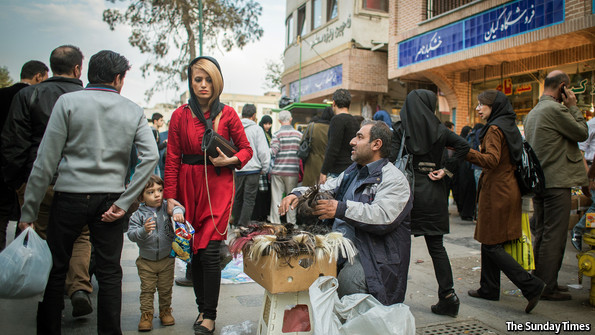
FROM THE MOUNTAINS of the Caucasus to the waters of the Indian Ocean, Iranians are watching intently as their government haggles with foreign powers over trade sanctions imposed to restrain its nuclear programme. Pointing to a corner of his office, the owner of a struggling cannery says: “See that television set? I watch it hour by hour, hoping for news that sanctions will be lifted.”
Iran says its nuclear programme is for peaceful purposes only. The West, not unreasonably, fears that Iran is building a bomb. In the hope of preventing a nuclear arms race in the Middle East, America and its allies have made it very difficult for Iran to engage in international commerce. The country’s oil exports have dwindled to half their former level. The Iranian government, for its part, has broken a habit of a lifetime and publicly held detailed discussions with countries it regards as hostile, including America. As this special report will explain, its motives are internal as much as external. All sides are keen to find a solution to this long-running stand-off. A deadline of November 24th has been set. An agreement to shackle the nuclear programme would have wide-ranging geopolitical consequences and could push Iran further towards modernity.

Wednesday, October 8, 2014

U.S., Iran, EU to meet in Vienna as nuclear deal deadline looms

Photo
12:07pm EDT
DUBAI/BRUSSELS (Reuters) - The top diplomats of the United States, Iran and the European Union will meet in Vienna next week, accelerating efforts to clinch a long-elusive deal to end a dispute over Tehran's nuclear programme by a Nov. 24 deadline.
European Union foreign policy chief Catherine Ashton is to meet Iranian Foreign Minister Mohammad Javad Zarif on Oct. 14 and the two will be joined the next day by U.S. Secretary of State John Kerry, the EU said in a statement.
The talks will take place with only six weeks to go before the self-imposed November target date to reach a diplomatic settlement to resolve the decade-old standoff over Iran's nuclear program and dispel fears of a new Middle East war.
Iranian and Western diplomats say significant differences remain over the future scope of Iran's uranium enrichment activity and that a successful outcome is not guaranteed, despite a political commitment to seek an agreement.

India rules out talks to de-escalate tensions till Pakistan stops firing


India rules out talks to de-escalate tensions till Pakistan stops firing
The Indian intelligence assessment is that at least 35 people have been killed in Pakistan over the last two days of cross-border firing.
NEW DELHI: India is ready for the long haul in the ongoing exchange of fire with Pakistan on the International Border (IB) in Jammu and Kashmir, with top government sources ruling out any talks to de-escalate tension till Islamabad puts a complete stop to its cross-border misadventure of targeting civilians with mortar shells. 

Prime Minister Narendra Modi did respond with a perfunctory "everything will be fine soon" to questions on the border tension at an IAF function on Wednesday evening, but top sources in the Indian security establishment said the government would not allow Pakistan to "dictate terms" any longer. 

"We are prepared for the long haul... Our massive and targeted retaliation is not going to stop. If talks or flag meetings are held, it will be on our terms and only after Pakistan stops firing," said a source. This came after one of the heaviest exchanges of fire in recent times that saw Pakistan targeting 63 BSF outposts along the IB on Tuesday night, and India retaliating by raining 1,000 mortar shells over 70 such Pakistani posts. 


Afghanistan and America

Don’t let history repeat itself

Barack Obama has dangerously reduced the military help America owes Afghanistan


IT TOOK a while, but Afghanistan has at last got a new president. After a four-month stand-off during which his rival, Abdullah Abdullah, accused him of stealing the election, Ashraf Ghani, a Pushtun technocrat with a notable temper, was inaugurated on September 29th. As part of the settlement, Dr Abdullah comes into the government in the newly created position of chief executive (in effect, prime minister). It remains unclear how the new arrangement will work; what is certain is that the stand-off damaged the economy, threatened to reopen ethnic divisions and, most dangerous of all, allowed the Taliban and other insurgents to regroup.

Wednesday, September 24, 2014

India's Supreme Court canceled most of the coal-mining licenses issued since 1993. Pictured, laborers load coal into trucks at an open-pit coal mine in Jharkhand, India's Bestacolla Colliery. Bloomberg News

NEW DELHI—India's Supreme Court canceled hundreds of coal-mining licenses, adding uncertainty beyond the struggling coal industry to the heart of Asia's third-largest economy.
The country's highest court on Wednesday said control over almost all coal blocks allotted since 1993 will have to be returned, saying they were granted illegally. The decision could aggravate a coal shortage in the country, analysts said.
The cancellation puts at least $47 billion of investments in such industries as power, steel and aluminum at risk, said Ashok Khurana, director general at the Association of Power Producers. "It does create uncertainty in the mind of an investor," he said. "He will think that even after 10,15 or 20 years, a court may strike down the policy on which he [based] his investment decision."

Why Pakistan's militants can still strike at will


In recent months the fortunes and allegiances of Pakistan's militants have proved mercurial. Formerly united fronts fractured while the army drove others out of their strongholds. Then al-Qaeda said it would take the initiative in South Asia proving, as the BBC's M Ilyas Khan reports, that the insurgents are still a potent force.

The claim by al-Qaeda that it carried out the 13 September attack on the Pakistan Navy's dockyard in Karachi city yet again shows the militants' ability to strike deep in Pakistan despite recent setbacks.
In a statement placed on one of its web portals, al-Qaeda claimed the operatives of its recently launched wing - al-Qaeda in the Indian Sub-continent (AQIS) - seized control of a Pakistani frigate in order to attack some nearby American vessels.
Fraud and Folly in Afghanistan
BY CHRIS MASON

The runoff round of the Afghan presidential election on June 14 was massively rigged, and the ensuing election audit was "unsatisfactory," a result of Afghan government-orchestrated fraud on a scale exceeding two million fake votes, completely subverting the will of the Afghan people. That is the watered-down conclusion of the press release of the European Union's yet-to-be-released report detailing its thorough and non-partisan investigation of the entire Afghan election. The report was completed last week, according to sources in Kabul who have seen it, but political pressure has so far resulted in heavy redaction and kept it from public release.

The key point is this: Ashraf Ghani did not win the election. The U.S. Center for Naval Analysis (CNA) concluded in July that it was mathematically impossible for Ghani to win, given Afghan demographics and the initial 46 percent to 32 percent first-round vote spread, according to sources familiar with the analysis. According to sources who reviewed the private report, the top experts in statistical analysis in the United States used every known computer model of election balloting and concluded that a Ghani victory was scientifically impossible. In simple terms, there is no mathematical doubt that Abdullah Abdullah won.