Showing posts with label Jess K.. Show all posts

Thursday, September 25, 2014

Iran's president urges US to focus on terror threat instead of fears his country wants nukes

Iran's president urges US to focus on terror threat instead of fears his country wants nukes Published September 24, 2014  The Associated Press

Iran President-1.jpg
Iran President Hassan Rouhani speaks during his keynote address at New America, a public policy institute and think tank, on Wednesday, Sept. 24, 2014 in New York. (AP Photo/Bebeto Matthews) 

afab07a79d9aa525600f6a70670075c1.jpg
Iran's President Hassan Rouhani, looks at a protester holding a picture who interrupted while he was speaking at New America, a public policy institute and think tank, on Wednesday, Sept. 24, 2014 in New York. Protesters say the individuals in the picture are all dissidents under house arrest in Iran and called on the President Rouhani to facilitate their release. (AP Photo/Bebeto Matthews) 
Iranian President Hasan Rouhani urged the United States on Wednesday to move beyond "insignificant" fears that his country seeks nuclear arms and challenged it to join his country in battling what he described as the global threat of Islamic extremism.
Rouhani also made clear he was not prepared to interfere in the case of Jason Rezarian, an American-Iranian journalist detained on unspecified charges in Iran, during a speech and question-and-answer session hosted by the New America think tank.
But most of his comments focused on the menace posed by the Islamic State terror group and attempts by his country and the U.S. to seal a deal to meet White House demands that Iran agree to significant long-term curbs on its nuclear program that could be used to make weapons in exchange for an end to crippling sanctions.
The Iranian president is addressing the U.N. General Assembly on Thursday, and his comments Wednesday touched on some of the issues he is likely to highlight.
The nuclear talks appear stuck two months before their extended Nov. 24 deadline. While the U.S. is formally joined by five other powers at the negotiating table with Iran, it is clear that the Americans are the lead negotiators, and Rouhani directed most of his comments at Washington.
He urged the U.S. government to "let go of pressure politics toward Iran" — a reference to Iranian complaints that Washington's demands at the talks are unrealistic. Repeating that Iran is not interested in nuclear arms, he urged the U.S. to "leave behind (this) insignificant issue."
Instead, Rouhani said, the two countries must focus on the fight against the Islamic State group and other extremist groups, the "real and serious common challenges which ... threaten the entirety of the world."
At the same time, he was critical of the U.S. bombing campaign of Islamic Group strongholds in Iraq and Syria and the growing coalition of countries seeking to stop the extremists by military means. "Bombing and airstrikes are not the appropriate way," he said, warning that "extraterritorial interference ... in fact only feeds and strengthens terrorism."
Blaming "the misunderstandings of the realities of the region by ... outsiders," Rouhani said wrong U.S. policies, including the invasions of Afghanistan in 2001 and Iraq in 2003, likely led to the birth of the Islamic State group by creating power vacuums exploited by the extremists.
He also suggested it was in the West's interest to reach a nuclear agreement with Iran, freeing Tehran to play a more active role in creating and maintaining stability in the Islamic world.
Even if a nuclear deal is sealed, it could face harsh opposition by Iranian hardliners and U.S. congressional critics united in one fear — that their side has given away too much. But Rouhani shrugged off opposition from inside his country and said it was up to President Barack Obama to deal with Congress.
Iran-U.S. tensions have eased since the election last year of the moderate Rouhani. A year ago, he and Obama spoke by telephone for 15 minutes, the first time the presidents of the United States and Iran had talked directly since the 1979 Iranian revolution and siege of the American embassy. The conversation was hailed as an historic breakthrough.
But American officials are furious with Iran for detaining Rezarian, a Washington Post journalist who has both American and Iranian citizenship, as well as his wife.
Iranian officials have not specifically said why the couple is being held, and Rouhani has dodged questions about their fate. Asked Wednesday about Rezarian, he said he would be freed if he is innocent of any crime.
"We must not prematurely express opinions about a case that hasn't reached the court yet," he said.

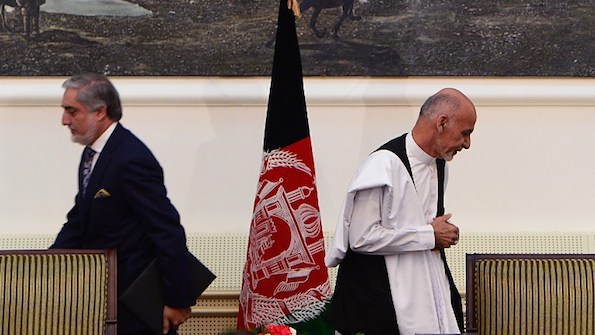
Afghanistan's disputed election: Divide and rule


Afghanistan's disputed election

Divide and rule


AFGHANISTAN has been held hostage by political stalemate for months. On September 21st it was finally broken, when the country’s two feuding presidential candidates, Ashraf Ghani and Abdullah Abdullah, signed a power-sharing agreement. Though the ceremony, at the Arg, the presidential palace in the capital Kabul, was brief and low-key, the deal will radically—and perhaps wisely—change the country’s political framework.
Neither man spoke and neither looked quite at ease. But the agreement will at least allow the new government to get on with the massive task of winning the confidence of a country that has been waiting for the deadlock to end. The four-page document, signed in the presence of outgoing President Hamid Karzai, and later by witnesses James Cunningham, the American ambassador, and Jan Kubis, the United Nations’ senior Afghanistan representative (both of whom were banned from the palace ceremony by Mr Karzai), divests the president of his vast powers.
The so-called National Unity Government intends for Mr Ghani, a Western-educated technocrat and former World Bank employee, to become president and for Dr Abdullah (or his nominee) to assume a the role of chief executive officer, newly created by decree and similar to the position of prime minister. A constitutional change, within the next two years, will confirm the role. The pair will split the allocation of senior positions, including ministries. They have also pledged to fix the country’s election system, which allows voter fraud to flourish.
The secret backroom deal, which many think usurps democratic process, was announced hours before the election commission declared Mr Ghani the winner, and Dr Abdullah the CEO. In a strange kowtowing to Dr Abdullah, who had argued that the poll was poisoned by undetectable fraud, neither the vote tallies nor the turnout were announced. The “everyone’s-a-winner” arrangement, similar to a politically-correct primary school sports day, came about after a bitterly disputed election season prompted threats to form a parallel government and fears of a return to civil war.
A former foreign minister, who came second to Mr Karzai in the election in 2009, Dr Abdullah easily won the first round of voting but without enough to avoid a run-off. In the second round, held on June 14th, Mr Ghani reversed the double-digit gap to pull off a comfortable victory, according to provisional results. Dr Abdullah alleged that he had been cheated again (after making the same charge in 2009) by “industrial scale” fraudand accused the election commission of helping rig the poll at the behest of Mr Karzai.
After the announcement of provisional results, John Kerry, the US secretary of state, travelled to Kabul. Both candidates embraced and vowed to form a government of national unity following an unprecedented audit of the vote, overseen by the UN. The audit found fraud on both sides made little change to the outcome, according to Western officials familiar with its results. That audit process started more than two months ago. In the meantime the candidates have bickered and their supporters have brawled in the audit halls.
It has been a costly few months for Afghanistan: the economy is battered and any trust in the government, widely viewed as predatory and uncaring, has evaporated. The Taliban, meanwhile, has capitalised on the dispute by launching large-scale attacks in numerous provinces. Afghan security forces are dying at a rate of about 100 a month in what has been the bloodiest summer of fighting since the war began.
All this makes the speedy signing of the bilateral security agreement between the government and America—which will allow about 14,000 foreign troops to remain past December—so vital. Mr Ghani has vowed to do what Mr Karzai refused to do and sign it within a week of his inauguration, which is likely to take place on September 29th. On paper, given the distrust between the two, the deal may look fragile and unworkable. But the pair has little choice than to make it succeed. An ethnically divided country with parallel governments is a form of mutually assured destruction, particularly given the country’s dependence on foreign money that will be impossible to source if this new government falls.
Mr Ghani, with Dr Abdullah riding shotgun, needs to demonstrate quickly that he is a partner worth funding in the long term. America can, in the short term, alleviate the country’s financial woes, harmed further through the political impasse that has emptied government coffers. It has an interest in giving the new government a chance; “They won’t spoil the ship for a ha’p’orth of tar,” says one Western official. But both Mr Ghani and Dr Abdullah owe results to their electorate, too. It has paid a steep price for this long-running squabble.
(Picture credit: AFP)