At least 15 people were killed in a blast apparently targeting police outside a polio vaccination centre in the southwestern Pakistani city of Quetta on Wednesday, according to officials.
The officers had been gathering outside the centre to accompany polio workers for the third day of a vaccination campaign in the province of Balochistan, of which Quetta is the capital.
"There are 15 dead, including 12 police, one paramilitary, and two civilians," a local police official told AFP, adding that at least 10 people had been wounded, nine of whom were police and one a civilian.
A doctor at Sandeman hospital in the city confirmed the toll.
"So far 15 bodies have been brought to the hospital," he told AFP.
"We are living in a war zone and I can't say anything about the nature of the blast," Sarfaraz Bugti, Balochistan home minister, told media in Quetta, adding that officials were investigating.
Pakistan is one of only three countries where polio remains endemic. Attempts to eradicate it have been badly hit by militant attacks on immunisation teams that have claimed nearly 80 lives since December 2012.
The most recent attack came in November last year, when unknown gunmen shot and killed the head of an immunisation programme in the Khyber Pakhtunkhwa district of Swabi.
The militants claim the polio vaccination drive is a front for espionage or a conspiracy to sterilise Muslims. In 2014 the number of polio cases recorded in Pakistan soared to 306, the highest in 14 years.
The expanded immunisation programme was launched in Pakistan in 1978 to protect children by immunising them against diseases including polio.
Showing posts with label Connor Reed. Show all posts
Showing posts with label Connor Reed. Show all posts
Thursday, January 14, 2016

At least five people were killed and dozens injured when an earthquake measuring 6.7 struck near Imphal in eastern India on Monday, sending people running from their homes and knocking out power to the city near the Burma border.
The US Geological Survey said the quake was 57 kms (35 miles) deep and struck 29 kms west of Imphal. It initially reported it had struck inside Burma, also known as Myanmar.
"Five people are confirmed dead and 33 have been injured," Anurag Gupta of India's National Disaster Management Authority told AFP.
Police in Imphal, capital of Manipur state, said walls, staircases and roofs in some buildings collapsed.
Residents said people fled their homes and power was down across the city.
“It was the biggest earthquake we’ve felt in Imphal,” disaster response worker Kanarjit Kangujam told Reuters by telephone from Imphal.
People in Bangladesh and Nepal ran from their homes, and the quake was also felt as far away as the former Burmese capital, Rangoon, about 1,176 kms (730 miles) to the south, residents said.
Indian Prime Minister Narendra Modi tweeted that he was in touch with authorities in the northeast.
An official at Myanmar’s Meteorological Department in Naypyidaw said there were no reports of damage or casualties on the Burma side of the border.
In April and May 2015, two massive earthquakes struck Nepal, killing more than 8,000 people, and in October, an earthquake hit a remote area in Afghanistan, killing over 200 people and sending shockwaves as far as New Delhi.
(FRANCE 24 with AFP, AP, REUTERS)
The Islamic State of Iraq and the Levant (ISIL) group has claimed responsibility for the coordinated bomb and gun attacks in the Indonesian capital, Jakarta, a news agency linked to ISIL reported on Thursday.
At least seven people, including five attackers, were killed in the explosions and gun battle between police and the attackers in the central business district of the city.
| Timeline of attacks |
|
Tito Karnavian, the Jakarta police chief, said ISIL was "definitely" behind the attack.
Karnavian told Reuters news agency that Indonesian ISIL fighter Bahrun Naim, who is believed to be in Syria, was "planning this for a while. He is behind this attack."
Earlier, police told Al Jazeera that ISIL had made specific threats before Thursday's attacks.
Six blasts occurred about 50 metres apart in the central business district, which also houses a United Nations office.
At least 20 people were injured in the security operations at the Sarinah shopping complex on Thamrin Street. Police said the attack had ended and that security forces were in control of the area.
There were conflicting reports on the number of casualties as the police battled the fighters.
Earlier, tweets from the account of Jeremy Douglas, regional representative of the UN office on Drugs and Crime for Southeast Asia and the Pacific, described a bomb and "serious" exchanges of gunfire on the street outside his office.
Al Jazeera's Step Vaessen, reporting from Jakarta, said a police post was destroyed in a grenade blast and that sporadic gunfire was heard in the downtown area of the capital.
 |
"Six gunmen on motorbikes entered the downtown area carrying long rifles, shooting into the crowd, with some carrying explosives," Vaessen said. "One of the gunman shot a police officer from close range."
Some gunmen on motorbikes reportedly escaped, police sources told Al Jazeera.
"Witnesses told Al Jazeera that they found nails on the streets near the affected area, indicating that the fragments came from the explosives used in the attacks," Vaessen said.
The attacks caused panic and prompted a security lockdown and enhanced checks in several areas in the city of 10 million.
"The police are still investigating, so we don't know how and why the attack happened. There were at least six explosions, and so far it looks like the police was the target," our correspondent said.
 |
| Police gathered outside a restaurant near the scene of an attack in central Jakarta [Beawiharta/Reuters] |
Presidential statement
Indonesian President Joko "Jokowi" Widodo, who was on a working visit in the West Java town of Cirebon, condemned the brazen attacks.
"This act is clearly aimed at disturbing public order and spreading terror among people," Jokowi said in statement on television.
Indonesia, the world's most populous Muslim nation, has been a victim of several bombing attacks in the past, claimed by Islamic groups.
Thursday's attacks, however, were the first major incidents in Indonesia's capital since the 2009 bombings of two hotels that killed seven people and injured more than 50.
The attacks come two days after jailed Islamic leader Abu Bakar Bashir appealed to a court to have his conviction for funding a "terrorist training camp" overturned.
The 77-year-old leader of the Jemaah Islamiyah network filed a judicial review of his 2011 conviction, when he was sentenced to 15 years in jail for setting up the camp in Aceh province. A higher court later cut the sentence to nine years.
Sunday, December 13, 2015
The head of Afghanistan’s main intelligence agency, the National Directorate of Security, resigned over policy disagreements with President Ashraf Ghani, laying bare divisions that have hindered efforts to fight the growing Taliban insurgency.
The resignation of Rahmatullah Nabil follows a series of setbacks in recent months including the fall of the northern city of Kunduz to the Taliban and a raid on Kandahar airport in the south on Tuesday in which 50 civilians, police and security personnel were killed.
Relations between Ghani and the NDS had been strained since at least the fall of Kunduz, which an inquiry last month blamed on poor leadership.
Later, Ghani dismissed some NDS officials including the provincial chief of the agency who he said had neglected their duty to defend Kunduz.
In the letter, Nabil said that over the past few months, there had been “a lack of agreement on some policy matters” and the president had imposed unacceptable conditions on his ability to do his job.
He said Ghani’s “repeated verbal summons” had put him under impossible pressure and forced his resignation.
The deputy spokesman for the president confirmed via Twitter that Ghani accepted his intelligence chief's resignation and is currently searching for an interim replacement.
The resignation raises fresh questions over the leadership of Afghanistan’s security apparatus, which has struggled to contain a Taliban insurgency that has gained momentum since international forces ended most combat operations last year.
The letter, a day after Ghani attended the Heart of Asia regional peace conference in Islamabad, also clouds prospects for a coordinated effort to resume peace talks including both the Taliban andPakistan that were broken off this year.
In an angrily worded post on Facebook that appeared before the resignation letter was made public, Nabil made clear his frustration with efforts to work with Pakistan, which many in Afghanistan accuse of controlling the Taliban.
The “red alert” issued by the city of Beijing on Tuesday over mass pollution has made many wonder if China can keep its pledge to curb its carbon emissions by the year 2030, but scientists say hitting the target is still possible.
It was the first time the smog-shrouded capital declared the highest pollution level on the four-tier system it adopted three years ago, and came while world leaders were hammering out a new global agreement to fight climate change in Paris.
The pollution peak, which forced authorities to shut schools and construction sites in the city of 21 million people, also highlighted China’s unflattering status as the world’s top polluter.
Asia’s economic powerhouse is being closely scrutinised at the COP 21 climate conference in the French capital, with many using Beijing’s “red alert” to argue it has to do more to limit greenhouse gas emissions.
The 2030 revolution
China, like India, faces the daunting task of establishing clear environmental objectives, while pursuing economic development targets that will raise the standard of living of millions of its citizens.
“The problems in Beijing are important, but the rest of the country must grow economically, which will result in an increase in carbon emissions,” Zhiyao Tang, an associate professor of environment at the University of Beijing, told FRANCE 24 on Tuesday.
Zhiyao is not part of the official delegation, but few know more about the quantities and rate of Chinese CO2 emissions than him. And one of the central commitments China adopted ahead of the COP 21 is a timetable for reducing gases that are responsible for global warming.
Indeed, Chinese leaders garnered worldwide praise by announcing last year that the country’s CO2 emissions would peak by 2030.
Zhiyao denies his studies are directly responsible for the historic emissions deadline.
“The group I work with on this issue is independent, but the government has been aware of our studies for the past several years” he said, insisting he did not know to what extent the Chinese government had drawn on his research to set the target.
2030 or 2023?
Zhiyao himself began studying the subject in the wake of the 2009 climate conference in Copenhagen that failed to produce a comprehensive international climate agreement. Since then, he and other colleagues have developed six emissions peak scenarios, grouping them in a study that was published in November of last year.
He contends that the government’s 2030 target is entirely realistic. In fact, a peak in emissions could even come sooner.
“If China receives financial and technological support from developed countries, the emissions peak could be reached before 2030,” the scientist said. One scenario published in the study calculated that China could reach its highest levels of CO2 output by 2026, and another as early as 2023.
While Zhiyao’s estimates may be heartening for the leaders gathered at the COP 21 and environmentalists around the world, he himself is careful about not crying victory too soon.
He pointed out that CO2 emissions will not plunge the year after the emissions peak is reached, be that 2031 or sooner. Instead, Zhiyao predicts they “will be stable for several years before they start to fall”.
Global warming has left millions of migrant workers in Gulf states increasingly worried that they might have to leave if the region becomes hotter, their leaders have said.
Some 1.5 million workers migrate from South Asia to the Gulf every year, according to the International Organization for Migration.
There is growing concern among mainly outdoor labourers that working conditions may become impossible in the future if the temperature continues to rise at its current rate.
A recent study said heat waves would make several places in the Gulf impossible for human survival if climate change was unchecked.
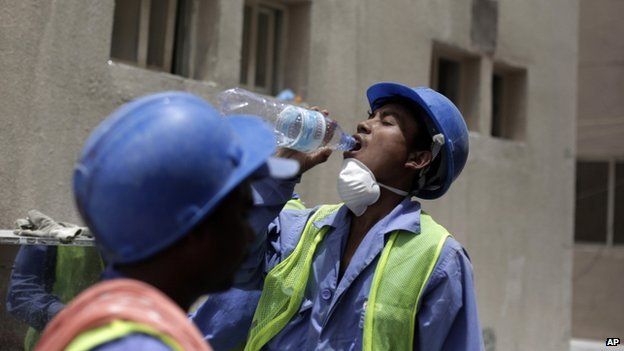
During the summer, the temperature in many parts of the Gulf already reaches 50C.
Soaring temperatures
For five months every year no outdoor work can be done during late mornings and early afternoons due to excessive heat, members of the migrant workers' community said.
"For outdoor labourers it would be a matter of life and death if temperatures continued to rise," said Maksud Alam, leader of the Nepalese migrant workers' community in Qatar.
"Under such circumstances people will be compelled to go back home but that would also mean losing jobs."

A leader of the Indian workers' community in the region, who did not want to be named, agreed.
"We come here with a mindset that it would be very hot but there will be a limit and we all are worried what happens when that point is crossed."
Money sent home by these workers mean a huge source of income for their countries.
Mr Alam said the issue of rising heat was discussed during a recent meeting of migrant workers' communities from different countries.
"The majority of the workers are not conscious of global warming or the ongoing Paris climate talks but they are well aware that the heat is going up and that is enough to keep them worried."
Impossible to live?
A recent study by scientists with the Massachusetts Institute of Technology said several coastal cities in the Gulf would not be inhabitable because of unbearable heat if the global temperature continued to rise at its present rate.
"Our results expose a specific regional hotspot where climate change, in the absence of significant mitigation, is likely to severely impact human habitability in the future," the authors of the study wrote in the journal Nature Climate Change.
 AP
The world is already nearly one degree Celsius warmer compared to the pre-industrial period.
Scientists say if the warming crosses two degrees, climate change impacts including sea level rise, droughts, heat waves, wildfires, floods, landslides, among others, will become uncontrollable.
West and Central Asia have observed between 0.4 and 2.5 degrees Celsius rise in temperature, according to the Intergovernmental Panel on Climate Change.
The UN scientific body has predicted temperatures to increase on average by 2 to 4 degrees Celsius by as early as 2046 in the region, with the most warming in the central areas including Iraq, Saudi Arabia, and Iran.
The IPCC has also said that the highest daily maximum temperature in the region will increase by 4 to 7 degrees Celsius.
No official figures
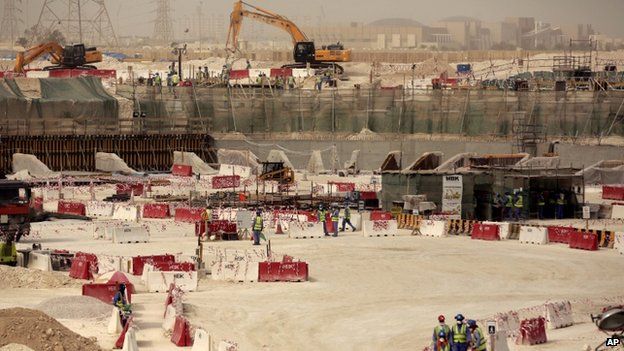
Media reports quoting the Indian and Nepalese embassy in Qatar say at least 1,200 workers from the two countries have died in the Gulf state since 2010.
 AP
How many of them died because of excessive heat is not known.
Leaders of workers communities say heart attacks caused by the high temperature are common.
"Headache and skin coming off are common problems I face working in the scorching sun," said Taleswar Sah from Nepal, who works as a goat shepherd in Qatar's desert area bordering Saudi Arabia.
"If it is already like this, we fear what might happen when the heat goes further up?"
Harun Rashid from India's Bihar state said tree plantations in recent years had helped a bit but the trend of temperature rise seemed to be undermining that solution.
"As a camel herder I spend most of my time in the desert and the rising heat frustrates me during summer time. And I am constantly thinking, 'will it mean I will have to go back?'"
Other members of the migrant workers community said the issue was even more pressing for those working in the construction sector.
"Those involved in scaffolding have more cases of heart attacks and fainting as they have to bear with more heat working higher from the ground," said a worker from Bangladesh who did not want to be named.
While migrant workers are increasingly concerned about the rising temperature, many of their host countries have been criticised for slowing the UN climate negotiations all these years, a charge they deny.
Since these countries are oil producers, there are allegations that they would block any deal that would keep their petroleum products in the ground.
Some of these countries, however, have embarked on development of renewable energies as well.
Qatar hosts 1.4 million migrant workers, with Nepalis and Indians accounting for 60% of this total.
It will host the 2022 World Cup and is ramping up its construction industry but was unavailable for comment at the Cop21 talks in Paris.
A Gulf official, who was not authorised to speak publicly, said the rising temperature was a global issue just like other climate change impacts such as floods and droughts.
"We are trying our best to achieve energy efficiency but this is a global challenge and everyone will have to take action," the official said.
Friday, December 4, 2015
Bangladesh's Mohona TV station says one of its reporters was shot and wounded while covering the funeral of one of two opposition leaders executed earlier Sunday.
Rajib Sen was covering the funeral of Bangladesh Nationalist Party leader Salahuddin Quader Chowdhury in Chittagong district.
Chowdhury and Ali Ahsan Mohammad Mujahid, secretary general of the main Islamist party Jamaat-e-Islami, were hanged together at Dhaka Central Jail.
The two opposition leaders were convicted of war crimes committed during Bangladesh's 1971 independence war against Pakistan despite concerns that the legal proceedings against them were flawed.
Sen was rushed to a hospital in Chittagong.
Bangladesh had been bracing for upheaval ahead of the executions, with supporters of the two opposition leaders threatening violence if the hangings went ahead.
Security had been strengthened near the jail and elsewhere as the executions took place. A few hours later a security detail escorted ambulances carrying the men's bodies to their ancestral homes where their families were to perform burial rituals.
The Jamaat-e-Islami party, which had already had two other senior leaders executed for war crimes, issued a statement calling for a nationwide general strike on Monday.
Chowdhury was convicted on of charges of torture, rape and genocide during Bangladesh's independence war against Pakistan, while Mujahid was found guilty on charges of genocide, conspiracy in killing intellectuals, torture and abduction.
On Wednesday, Bangladesh's Supreme Court upheld their death sentences, and on Saturday, President Mohammad Abdul Hamid rejected a clemency appeal, clearing the way for the executions. The families of Chowdhury and Mujahid met them for the last time inside Dhaka Central Jail on Saturday evening, authorities said.
Political retribution
Jamaat-e-Islami and the Bangladesh Nationalist Party say the trials were politically motivated. Prime Minister Sheikh Hasina has denied the allegations. She has acknowledged that she faced international pressure for trying opposition figures for war crimes, but vowed to continue the trials "to ensure justice for the families of the slain people" from the 1971 war.
More than 15 people, mostly leaders of Jamaat-e-Islami, have been convicted of war crimes.
The party had campaigned openly against independence for Bangladesh, which was part of Pakistan until the 1971 war. Bangladesh's government says that Pakistani soldiers, aided by local collaborators, killed 3 million people and raped 200,000 women during the war.
Mujahid, 67, was the head of Islami Chhatra Sangha, then the student wing of Jamaat-e-Islami. He was accused of being the mastermind behind the killing of intellectuals, including teachers and journalists, days before the Pakistani military surrendered to a joint force of freedom fighters and Indian army units on Dec. 16, 1971, after a bloody nine-month war.
Chowdhury, 66, whose father was the speaker of Pakistan's National Assembly and, at times, the acting president of Pakistan, also actively opposed Bangladeshi independence. He was accused of carrying out war crimes, including killing more than 200 civilians, mostly minority Hindus, during the independence war, according to evidence presented at the tribunal.
US lawmakers overseeing foreign policy described the war crimes tribunal, set up in 2013, as "very flawed" and a means of political retribution. The State Department said Friday that executions should not take place until it it's clear that the trial process meets international standards.
Human Rights Watch said the tribunal allowed the prosecution to call 41 witnesses, while Chowdhury's defense was limited to four witnesses. The New York-based group said Mujahid was sentenced to death for instigating his subordinates to commit abuses, although no subordinates testified or were identified.
(FRANCE 24 with AP)
US says strike on Kunduz hospital due to ‘preventable human error'
Latest update : 2015-11-26
The US airstrike that killed 31 civilians at a hospital in Afghanistan last month resulted from preventable errors by soldiers and airmen who violated rules of engagement and have since been removed from duty, military officials said on Wednesday.
A briefing in Kabul provided the latest U.S. explanation but left some questions unanswered about an attack in which an internationally run hospital was subjected to barrages of heavy fire from an AC-130 gunship. Among them: how the attack was ordered in a populated area based on a ground commander’s request with little apparent review by higher headquarters.
Gen. John Campbell, the top U.S. commander in Afghanistan, said the airstrike was supposed to have been directed at a nearby facility being used as a Taliban command center but the warplane fired at the wrong building.
After the plane’s targeting sensors malfunctioned, he said, the crew relied on a physical description to home in on the target. But no Americans on the ground were in position to see the hospital.
“This was a tragic but avoidable accident caused primarily by human error,” said Campbell, who described the results of parallel investigations to reporters in Afghanistan and listening in at the Pentagon in Washington.
A summary of one of the investigations, obtained by The Associated Press, said that witnesses differed in their versions of how and why the strike was authorized. It also said the Special Forces commander who called in the strike, identified by AP sources as a major, had been given the coordinates of the hospital two days before but said he didn’t recall seeing them.
Investigators found that the aircrew continued the attack despite observing no hostile activity from the hospital, operated by the international group Doctors Without Borders. It found no evidence that armed Taliban were operating from there.
Campbell said several people had been removed from duty over the incident as they await potential criminal prosecution or administrative discipline, although he declined to say who and how many. His spokesman, Brig. Gen. Wilson Shoffner, said those who called in and carried out the airstrike violated U.S. rules of engagement and used force that was disproportionate to the threat – language that suggests a possible international law violation.
Neither Campbell nor Shoffner addressed the broader policy and leadership questions raised by the attack, the latest in a line of airstrike mistakes in Afghanistan that at various times have led to tightening of the rules of engagement. Shoffner would not say whether Campbell, who was out of the country during the incident, was interviewed as part of the investigation.
In a blistering statement, Doctors without Borders director Christopher Stokes said, “The frightening catalog of errors outlined today illustrates gross negligence on the part of U.S. forces and violations of the rules of war.”
He renewed his group’s call for an independent international investigation, something the U.S. has blocked by declining to consent.
Doctors Without Borders has long raised the possibility that the hospital was targeted deliberately. The AP previously reported that the military believed the hospital had been taken by the Taliban, and Afghan officials in recent days have argued that the strike was justified for that reason. Campbell did not address those issues as he asserted that the assault was a mistake.
According to the report obtained by AP and to Campbell’s account, the AC-130 was sent on short notice after a report of “troops in contact.”
As a result, the aircrew did not get a pre-flight briefing and was not given a list of protected facilities on a “no strike” list that should have included the hospital.
During the flight, Campbell said, the aircraft’s electronic systems malfunctioned, preventing it from transmitting video or sending or receiving email. That meant the Air Force controller on the ground was hampered in aiding the targeting.
Campbell said the strike was requested by Afghan forces but relayed through a U.S. Special Forces commander who was located a half-mile from the hospital, at the provincial governor’s compound, where he had been under attack for five days.
The AC-130 crew was given the coordinates for an Afghan intelligence building about 450 yards (410 meters) from the hospital, where Afghan forces were said to be in danger. But because the plane had moved to avoid a missile, its targeting sensors were off, and they pointed the crew to an open field.
The crew then relied on a physical description relayed by the commander to find what it thought was the right target. Even when its computer eventually found the correct coordinates, Campbell said, the crew ignored them because it was “fixated on the physical description of the facility.”
Immediately before firing, the aircrew relayed the coordinates of the hospital, to its headquarters, where officers knew it to be on the no-strike list, Campbell said. But nobody realized the mistake in time.
(AP)
Subscribe to:
Posts (Atom)